Bayes’ Theorem: Intuition, NumPy, and Real-World Inference
A student-first Q&A guide to reasoning under uncertainty with visible plots and practical examples
Probability
Statistics
NumPy
Tutorial
Bayesian Thinking
Author
Rishabh Mondal
Published
March 19, 2026
Bayesian Thinking for Students
Bayes’ Theorem
Bayes’ theorem looks like a formula, but it is really a way of updating belief when new evidence arrives. This post is written to make that update feel intuitive, visual, and computationally concrete with NumPy.
This guide is designed to work in three ways:
as a student-first explanation of conditional probability
as a problem-solving tutorial with NumPy and visible plots
as an interview-prep guide with a dropdown question after every topic
What You Will Build Intuition For
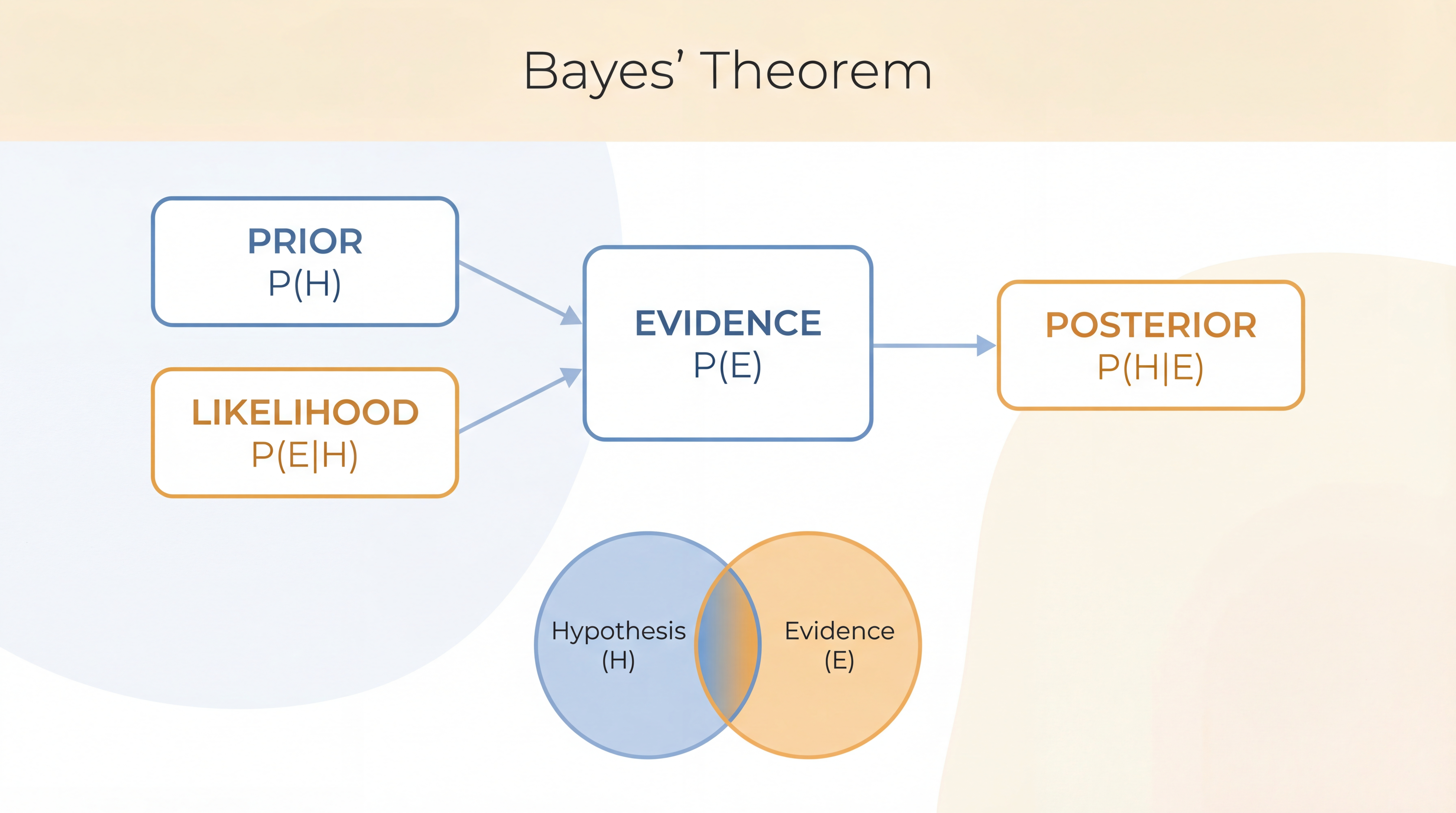
Prior, likelihood, evidence, and posterior
Why the base-rate fallacy feels so convincing
How to turn Bayes’ theorem into NumPy code
Why Bayes shows up in diagnosis, spam filtering, and machine learning
Student Friendly The math is introduced through intuition first, formula second.
Visible Plots Matplotlib figures are shown directly, while the plotting code is hidden in dropdowns.
NumPy Driven Every major calculation is written in a way you can reproduce and extend.
A light-theme Bayes’ theorem intuition graphic connecting prior, likelihood, evidence, posterior, and overlapping probability regions.
Learning Promise
By the end, you should be able to:
read Bayes’ theorem in words instead of symbols only
compute posteriors using counts and probabilities
build NumPy-based Bayes calculations from scratch
interpret why posterior belief can differ sharply from prior belief
This post is especially inspired by the visual, area-based intuition popularized by 3Blue1Brown and the machine-learning framing used by Machine Learning. Links are included in the reference section.
Q1. What question does Bayes’ theorem actually answer?
Answer: Bayes’ theorem answers a very specific question:
If I observe some evidence, how should I update my belief about a hypothesis?
That is the heart of Bayesian reasoning. You start with a belief before seeing evidence, then revise it after seeing evidence.
The everyday structure looks like this:
I had an initial belief.
I saw a clue.
I want to know how much that clue should change my belief.
This is why Bayes’ theorem appears in:
medical testing
spam filtering
diagnosis
search and recommendation
machine learning classification
The theorem is not only about probability symbols. It is about belief revision under uncertainty.
That phrasing matters. Many students first meet Bayes’ theorem as a formula to memorize. That usually makes it feel harder than it really is. The deeper view is simpler:
there is some hidden state you care about
there is some observable signal you receive
you want to connect the signal back to the hidden state
In other words, Bayes is useful whenever reality is partly hidden and all you get are clues.
That is why it appears in problems like:
“Given this symptom, how likely is the disease?”
“Given these words, how likely is spam?”
“Given these sensor readings, how likely is a fault?”
“Given this sequence of events, which explanation is now most plausible?”
Once you see Bayes that way, the formula stops being isolated math. It becomes a general reasoning pattern.
Interview Check: What is the central job of Bayes’ theorem in one sentence?
Its central job is to update the probability of a hypothesis after observing new evidence.
Q2. What do prior, likelihood, evidence, and posterior really mean?
Answer: These four words are the vocabulary of Bayes’ theorem.
Term
Meaning
Simple question
Prior
Belief before seeing the new evidence
What did I believe before the clue arrived?
Likelihood
How compatible the evidence is with the hypothesis
If the hypothesis were true, how likely is this clue?
Evidence
Overall probability of seeing the clue
How surprising is this clue overall?
Posterior
Updated belief after using the clue
What should I believe now?
A student-friendly way to remember this is:
Prior = start
Likelihood = fit of the clue
Evidence = normalizing denominator
Posterior = final updated belief
If that vocabulary feels abstract, think about a disease test:
prior = disease prevalence before the test result
likelihood = how likely a positive test is if a person truly has the disease
evidence = how often positive tests happen overall
posterior = probability the person truly has the disease after a positive result
One subtle but important point is that the likelihood is not a probability of the hypothesis. Students often mix this up.
P(E | H) asks about the evidence under the hypothesis.
P(H | E) asks about the hypothesis after seeing the evidence.
Those look similar on paper, but they answer different questions. Bayes’ theorem is the bridge between them.
Another useful way to think about these terms is as a story:
Prior: what you believed before the new clue.
Likelihood: how well the clue fits a given explanation.
Evidence: how common the clue is overall.
Posterior: what you believe after combining all of that.
That story structure makes Bayes much easier to apply in interviews and exams, because you can map almost every word problem onto it.
Interview Check: What is the difference between prior and posterior?
The prior is your belief before seeing the evidence, while the posterior is your updated belief after using the evidence.
Q3. What does conditional probability mean before Bayes even enters the picture?
Answer: Before Bayes’ theorem, you need one simpler idea:
conditional probability means we restrict attention to a smaller world where some condition is already known to be true.
If I ask for P(H | E), I am saying:
ignore all cases where E did not happen
focus only on the cases where E happened
ask what fraction of that smaller group also satisfies H
That is why the vertical bar | is often read as “given that”.
Let us make that idea concrete with counts. Suppose we have a table of people, where:
for P(H | E), you divide only by the cases where evidence is present
That “change of denominator” is the entire intuition behind conditioning.
If you remember that, Bayes’ theorem becomes much easier because it is really about computing a conditional probability when it is hard to measure directly.
Interview Check: What changes when we move from P(H) to P(H | E)?
The reference group changes: instead of dividing by all cases, we divide only by the cases where the evidence is true.
Part 2: Reading the Formula Without Fear
Q4. What is Bayes’ theorem, and how should I read it in plain language?
The probability of the hypothesis given the evidence equals the probability of the evidence under the hypothesis, multiplied by the prior probability of the hypothesis, divided by the total probability of the evidence.
Or even more simply:
posterior = likelihood x prior / evidence
The most common mistake is to mix up these two quantities:
P(H | E) = probability of the hypothesis after seeing the evidence
P(E | H) = probability of seeing the evidence if the hypothesis were true
The evidence term is what keeps the result a valid probability. Without it, you would only have an unnormalized score.
There is also a very practical way to read the formula:
start from the prior
reward the hypothesis if the evidence fits it well
then divide by how common the evidence is overall
That last step matters because evidence should count less if it is common everywhere. A clue that appears under almost every explanation is not very informative. A clue that strongly favors one explanation over others is much more informative.
Interview Check: Why is P(H|E) generally not equal to P(E|H)?
Because one asks how likely the hypothesis is after the evidence, while the other asks how likely the evidence is if the hypothesis were true. They answer different conditional questions.
Q5. Why is the denominator P(E) so important, and where does it come from?
Answer: The denominator is the probability of seeing the evidence at all. It is often called the evidence or the marginal probability of the evidence.
In many beginner problems, this is the part people do not know how to compute. The trick is:
break the evidence into all mutually exclusive ways it could happen, then add those pieces.
Positive via true disease: 0.0099
Positive via healthy group: 0.0495
Total evidence P(positive): 0.0594
This section is worth slowing down for, because it explains why Bayes is not a magic trick. The denominator is not mysterious. It is just the total size of the evidence pool.
If you think in counts, it becomes even clearer:
numerator = the part of the evidence pool that supports the hypothesis
denominator = the whole evidence pool
That is exactly why the posterior is a fraction of one region inside another.
Interview Check: In a binary Bayes problem, what are the two most common pieces used to build P(E)?
They are the evidence coming from the hypothesis being true and the evidence coming from the hypothesis being false.
Q6. Why do counts and frequencies often feel easier than symbols?
Answer: Human intuition usually handles counts better than abstract percentages.
Suppose a disease has:
prevalence = 1%
sensitivity = 99%
specificity = 95%
Instead of thinking in abstract probabilities, imagine 10,000 people:
about 100 truly have the disease
about 9,900 do not
about 99 true positives appear
about 495 false positives appear
Now the important question becomes:
Out of all positive tests, how many are truly sick?
That is easier to reason about than the formula alone.
This is exactly the kind of perspective emphasized by visual explanations of Bayes: not “memorize the fraction,” but “see the fraction as a part of a whole.”
This is also why frequency language is powerful in teaching:
“99 out of 100 sick people test positive”
“495 healthy people still test positive”
“So among all positive tests, only 99 are true positives”
That feels more human than a stack of symbols.
In interviews, if you get stuck on symbolic Bayes, converting the problem into an imaginary population like 1,000 or 10,000 often unlocks the answer immediately.
Interview Check: Why do frequency-based explanations often help students more than symbolic ones?
Because it is easier to picture actual counts like 99 true positives out of 594 positive tests than to reason purely with abstract symbols and conditional probabilities.
Q7. Can I build an area intuition instead of memorizing the formula?
Answer: Yes. This is one of the most helpful ways to think about Bayes’ theorem.
Imagine the full set of possibilities as a rectangle of area 1.
the part where the hypothesis is true has area P(H)
the part where the evidence is true has area P(E)
the overlapping region has area P(H ∩ E)
Then:
\[
P(H \mid E) = \frac{P(H \cap E)}{P(E)}
\]
That means:
once the evidence is known, we only look inside the evidence region, and then ask what fraction of that region belongs to the hypothesis.
This is deeply important because it turns Bayes into a geometric idea:
evidence restricts the sample space
the posterior is a proportion inside that restricted space
That is why the theorem feels so natural in the 3Blue1Brown explanation. It is not just algebra. It is a picture of how the world gets narrowed after a clue arrives.
The area view also explains an important sanity check:
if the evidence is equally common whether H is true or false, the posterior should stay close to the prior
if the evidence is much more common under H, the posterior should rise
if the evidence is much less common under H, the posterior should fall
So even before calculation, Bayes gives you a directional intuition.
Interview Check: In the area interpretation, what does the denominator P(E) represent?
It represents the whole restricted evidence region inside which we measure the share belonging to the hypothesis.
Part 3: Medical Testing, Base Rates, and Visual Intuition
Q8. What are sensitivity and specificity, and why are they different?
Answer: These are two of the most important terms in medical-testing problems.
Sensitivity tells you how well a test catches people who really have the disease.
That is all sensitivity and specificity mean at the most practical level.
Interview Check: What is the difference between sensitivity and specificity?
Sensitivity measures how often truly sick people test positive, while specificity measures how often truly healthy people test negative.
Q9. Why does a positive medical test not automatically mean the disease is likely?
Answer: Because the base rate matters.
If the disease is rare, even a good test can generate many false positives simply because the healthy group is much larger than the sick group.
With the same numbers as above:
disease prevalence = 1%
sensitivity = 99%
specificity = 95%
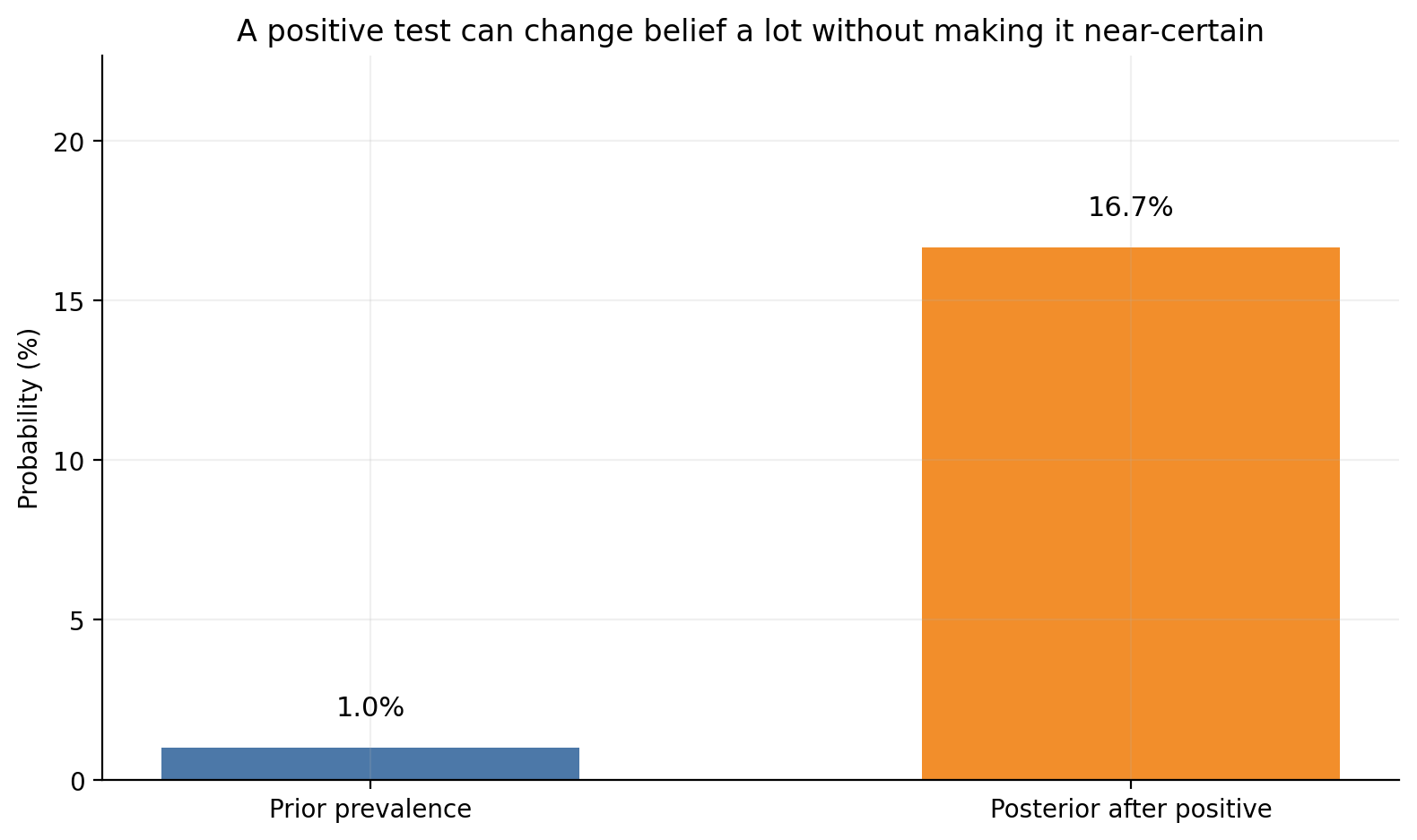
The prior is only 1%, but the posterior after a positive test is only around 16.7%, not 99%.
That feels surprising because people often confuse:
Prior prevalence: 1.00%
Posterior after a positive test: 16.67%
Show Matplotlib code for this figure
prior_pct = prior *100posterior_pct = posterior_positive *100fig, ax = plt.subplots(figsize=(8, 4.8))bars = ax.bar( ["Prior prevalence", "Posterior after positive"], [prior_pct, posterior_pct], color=[BLUE, ORANGE], width=0.55)for bar, value inzip(bars, [prior_pct, posterior_pct]): ax.text(bar.get_x() + bar.get_width()/2, value +1, f"{value:.1f}%", ha="center", fontsize=11)ax.set_ylabel("Probability (%)")ax.set_ylim(0, max(22, posterior_pct +6))ax.set_title("A positive test can change belief a lot without making it near-certain")plt.tight_layout()plt.show()
Interview Check: What is the base-rate fallacy in this context?
It is the mistake of focusing on the test result or test accuracy while ignoring how rare the disease was to begin with.
Q10. Can I make the same example feel visual using a population plot?
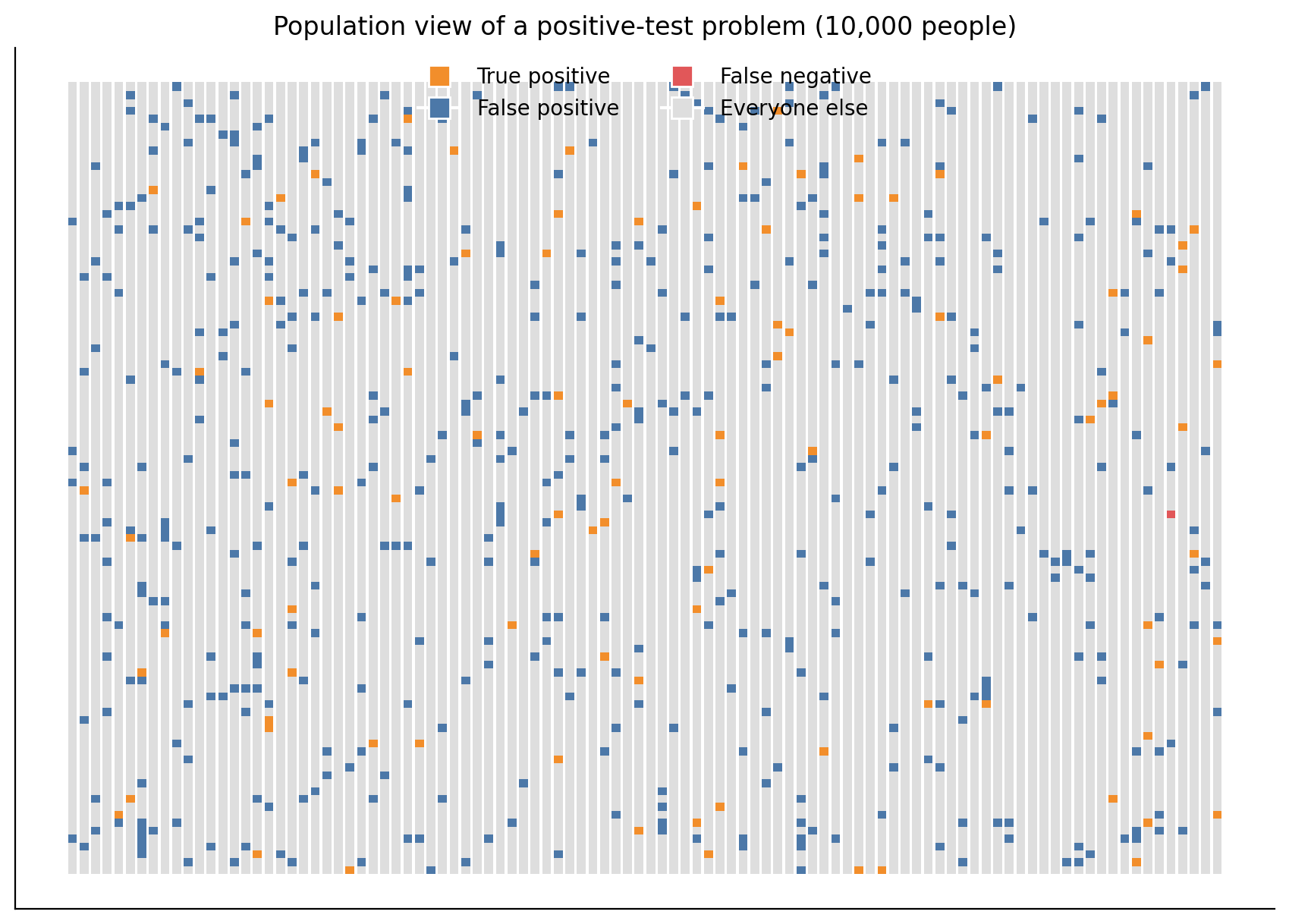
Answer: Yes. A population plot makes Bayes feel concrete.
Here we simulate 10,000 people and color-code:
true positives
false positives
everyone else
The key insight is that even a relatively small false-positive rate can create many false positives when the healthy population is huge.
Interview Check: Why can there be many false positives even when specificity is high?
Because the healthy group can be much larger than the sick group, so a small false-positive rate applied to a huge group still creates many false positives.
Q11. How does the posterior change as the prior prevalence changes?
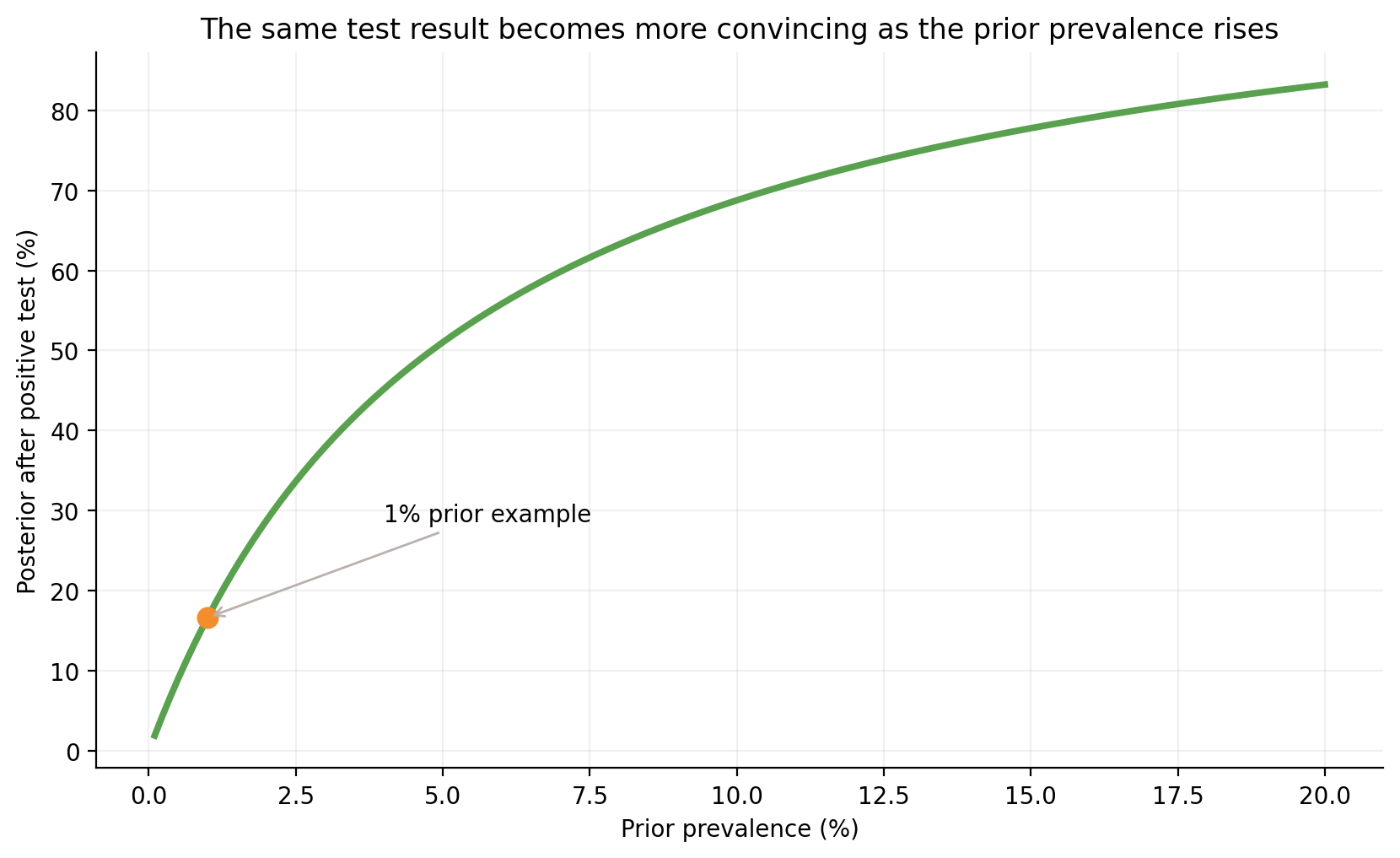
Answer: This is one of the most important Bayes insights:
The same evidence can mean very different things when the prior changes.
For a fixed medical test:
if prevalence is tiny, the posterior after a positive result may still be modest
if prevalence is larger, the same positive result becomes much more convincing
Let’s sweep the prior prevalence from very small to moderately large values and compute the posterior after a positive test.
Posterior at 1% prevalence: 0.1711
Posterior at 10% prevalence: 0.6879
Show Matplotlib code for this figure
fig, ax = plt.subplots(figsize=(8.4, 5.2))ax.plot(priors *100, posterior_curve *100, color=GREEN, linewidth=2.8)ax.scatter([1], [posterior_positive *100], color=ORANGE, s=70, zorder=3)ax.annotate("1% prior example", (1, posterior_positive *100), xytext=(4, posterior_positive *100+12), arrowprops=dict(arrowstyle="->", color=GRAY), fontsize=10)ax.set_xlabel("Prior prevalence (%)")ax.set_ylabel("Posterior after positive test (%)")ax.set_title("The same test result becomes more convincing as the prior prevalence rises")plt.tight_layout()plt.show()
Interview Check: Why does the same positive test result lead to different posteriors under different priors?
Because Bayes’ theorem combines the evidence with the prior, so the starting belief changes how strongly the same evidence updates the final belief.
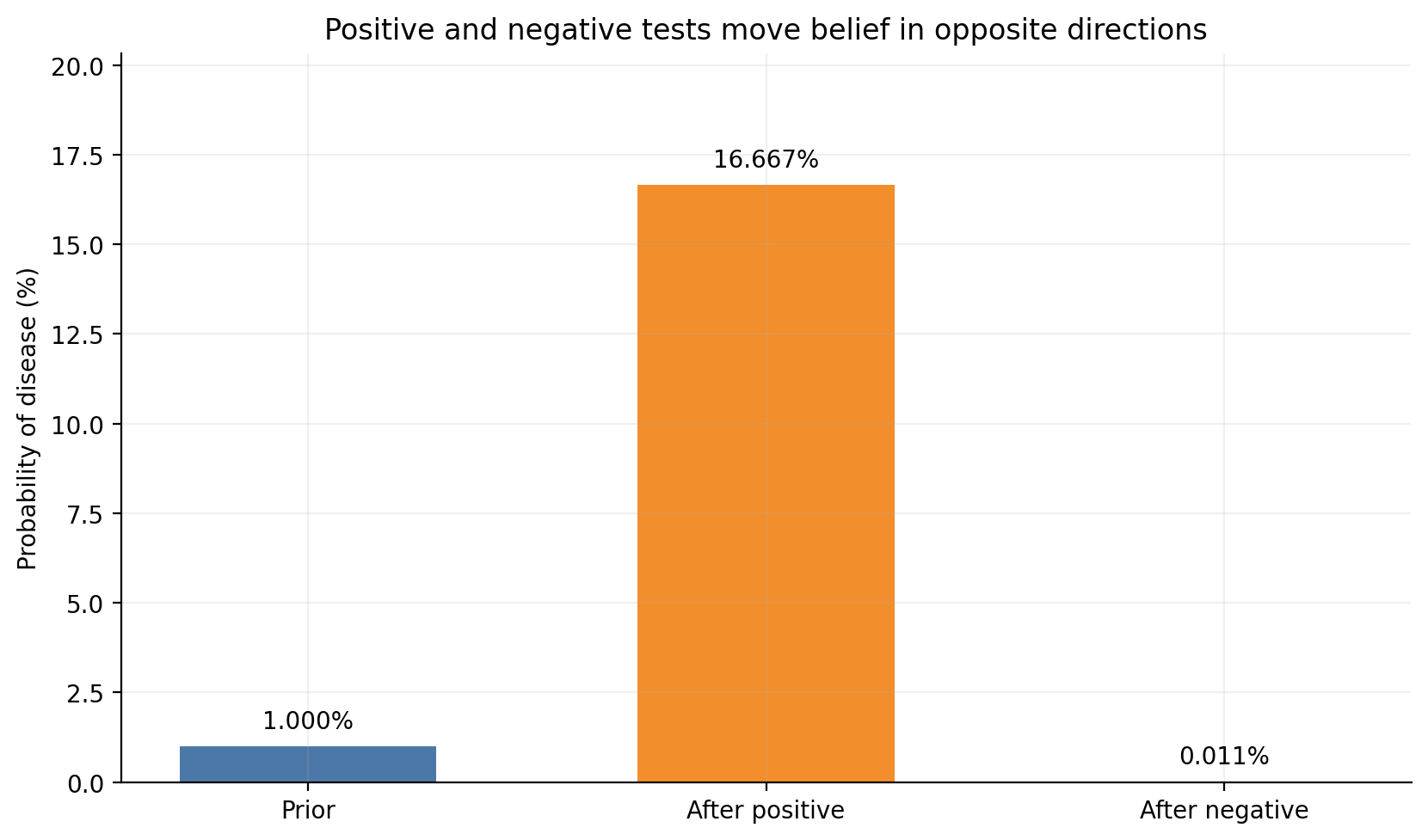
Q12. What happens after a negative test result, and why is that also a Bayes update?
Answer: Bayes’ theorem does not only work for positive evidence. A negative result is also evidence.
The positive result raises the belief sharply, while the negative result pushes it down to a tiny value. That makes intuitive sense:
a positive test is evidence for disease
a negative test is evidence against disease
But the strength of each update depends on the test characteristics. If sensitivity were poor, a negative result would not be very reassuring. If specificity were poor, a positive result would not be very convincing.
Show Matplotlib code for this figure
values = np.array([prior *100, posterior_positive *100, posterior_negative *100])labels = ["Prior", "After positive", "After negative"]fig, ax = plt.subplots(figsize=(8.4, 5.0))bars = ax.bar(labels, values, color=[BLUE, ORANGE, GREEN], width=0.56)for bar, value inzip(bars, values): ax.text( bar.get_x() + bar.get_width() /2, value +max(values) *0.03,f"{value:.3f}%", ha="center", fontsize=10 )ax.set_ylabel("Probability of disease (%)")ax.set_ylim(0, max(values) *1.22)ax.set_title("Positive and negative tests move belief in opposite directions")plt.tight_layout()plt.show()
Interview Check: Why can a negative result be much more reassuring than a positive result is convincing?
Because the update strength depends on sensitivity, specificity, and the base rate, and those may make negative evidence much stronger than positive evidence in a given problem.
Q13. How do likelihood ratios summarize the strength of evidence?
Answer: Likelihood ratios compress a Bayes update into a single “evidence strength” number.
LR+: 19.8
LR-: 0.0105
Posterior via odds after positive: 0.1667
This is a slightly more advanced way to think, but it is extremely useful:
Bayes in probability form updates probabilities
Bayes in odds form updates odds
The odds form is often easier in diagnostics and decision-making because the evidence multiplier is explicit.
Interview Check: What does an LR+ far larger than 1 mean?
It means a positive result is much more likely when the hypothesis is true than when it is false, so the evidence strongly supports the hypothesis.
Part 4: Updating Beliefs with NumPy
Q14. How can I write Bayes’ theorem for multiple hypotheses using NumPy?
Answer: Bayes is not limited to one hypothesis versus not-hypothesis. You can update belief across many competing explanations at once.
Suppose you have three boxes:
Box A
Box B
Box C
You start with prior probabilities for the boxes, then observe evidence such as drawing a red ball. Each box gives a different likelihood for seeing red.
priors = np.array([0.50, 0.30, 0.20])likelihood_red = np.array([0.10, 0.70, 0.40])unnormalized = priors * likelihood_redposterior = unnormalized / unnormalized.sum()print("Priors:", priors)print("Likelihood of red under each box:", likelihood_red)print("Posterior after observing red:", posterior.round(4))print("Posterior sums to:", posterior.sum())
Priors: [0.5 0.3 0.2]
Likelihood of red under each box: [0.1 0.7 0.4]
Posterior after observing red: [0.1471 0.6176 0.2353]
Posterior sums to: 1.0
This is the vector form of Bayes:
multiply prior by likelihood
normalize by dividing through the total
That same pattern appears in hidden-state models, classification, sensor fusion, and probabilistic filtering.
Interview Check: Why do we divide by unnormalized.sum() in the multi-hypothesis case?
Because the raw scores must be normalized so that the posterior probabilities sum to 1.
Q15. How do repeated pieces of evidence update a belief over time?
Answer: Bayes is not only for one update. It is naturally sequential.
Imagine two competing hypotheses:
H_fair: the coin is fair, so P(H) = 0.5
H_biased: the coin is biased toward heads, so P(H) = 0.8
Now suppose we observe a sequence of coin tosses:
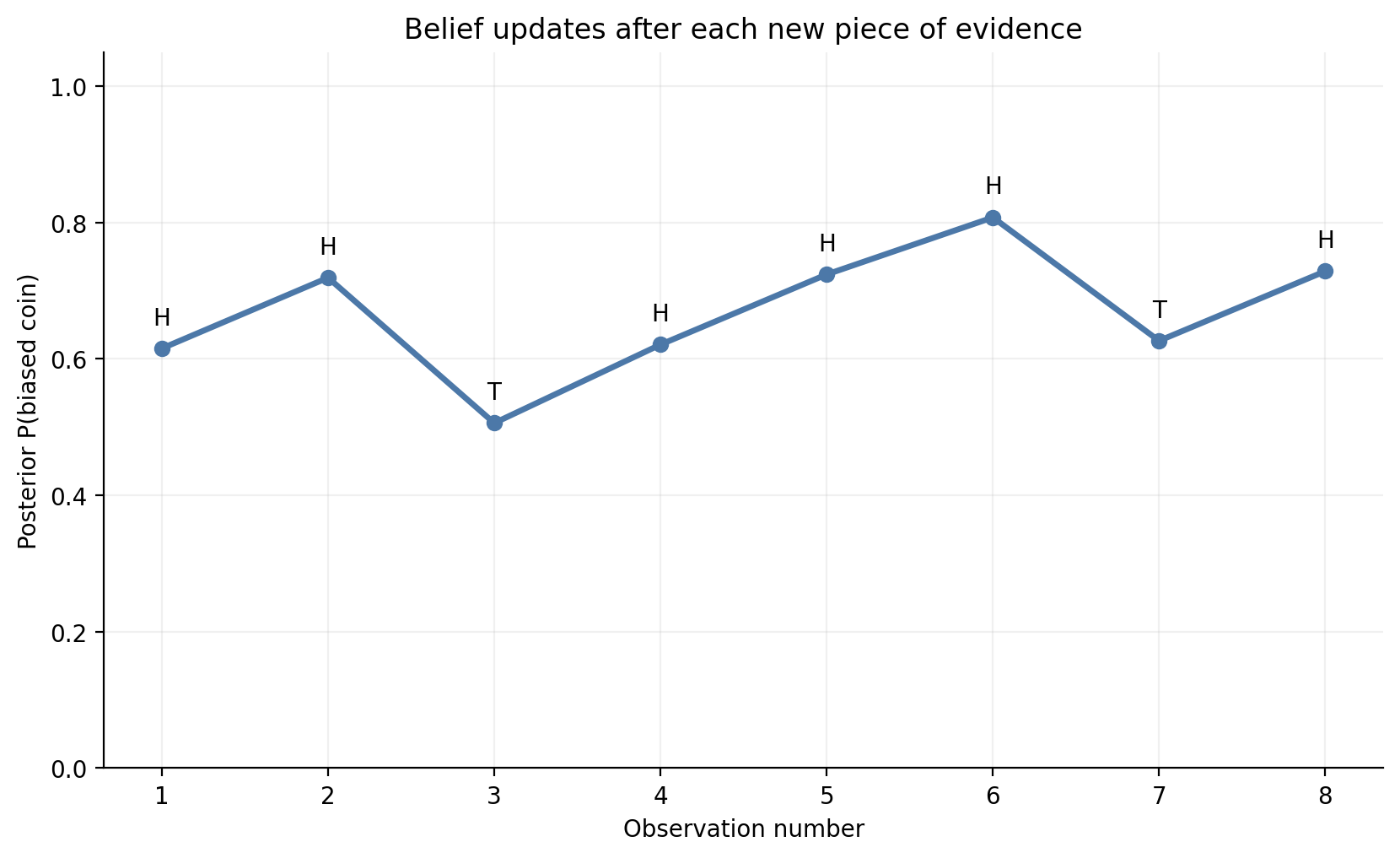
H, H, T, H, H, H, T, H
After each toss, we update the posterior belief in the biased-coin hypothesis.
sequence = np.array(list("HHTHHHTH"))prior_hyp = np.array([0.5, 0.5]) # fair, biasedp_heads = np.array([0.5, 0.8])p_tails =1- p_headsposteriors_biased = []current = prior_hyp.copy()for outcome in sequence: likelihood = p_heads if outcome =="H"else p_tails current = current * likelihood current = current / current.sum() posteriors_biased.append(current[1])print("Posterior of biased hypothesis after final toss:", round(posteriors_biased[-1], 4))
Posterior of biased hypothesis after final toss: 0.7286
Show Matplotlib code for this figure
steps = np.arange(1, len(sequence) +1)fig, ax = plt.subplots(figsize=(8.4, 5.2))ax.plot(steps, posteriors_biased, marker="o", color=BLUE, linewidth=2.5)for i, outcome inenumerate(sequence): ax.text(steps[i], posteriors_biased[i] +0.035, outcome, ha="center", fontsize=10)ax.set_ylim(0, 1.05)ax.set_xticks(steps)ax.set_xlabel("Observation number")ax.set_ylabel("Posterior P(biased coin)")ax.set_title("Belief updates after each new piece of evidence")plt.tight_layout()plt.show()
This is one of the deepest ideas in Bayesian reasoning:
today’s posterior becomes tomorrow’s prior.
Interview Check: What does it mean to say that today’s posterior becomes tomorrow’s prior?
It means Bayesian updating can be repeated: after one observation updates your belief, that updated belief becomes the starting point for the next observation.
Q16. How do multiple test results update the same belief step by step?
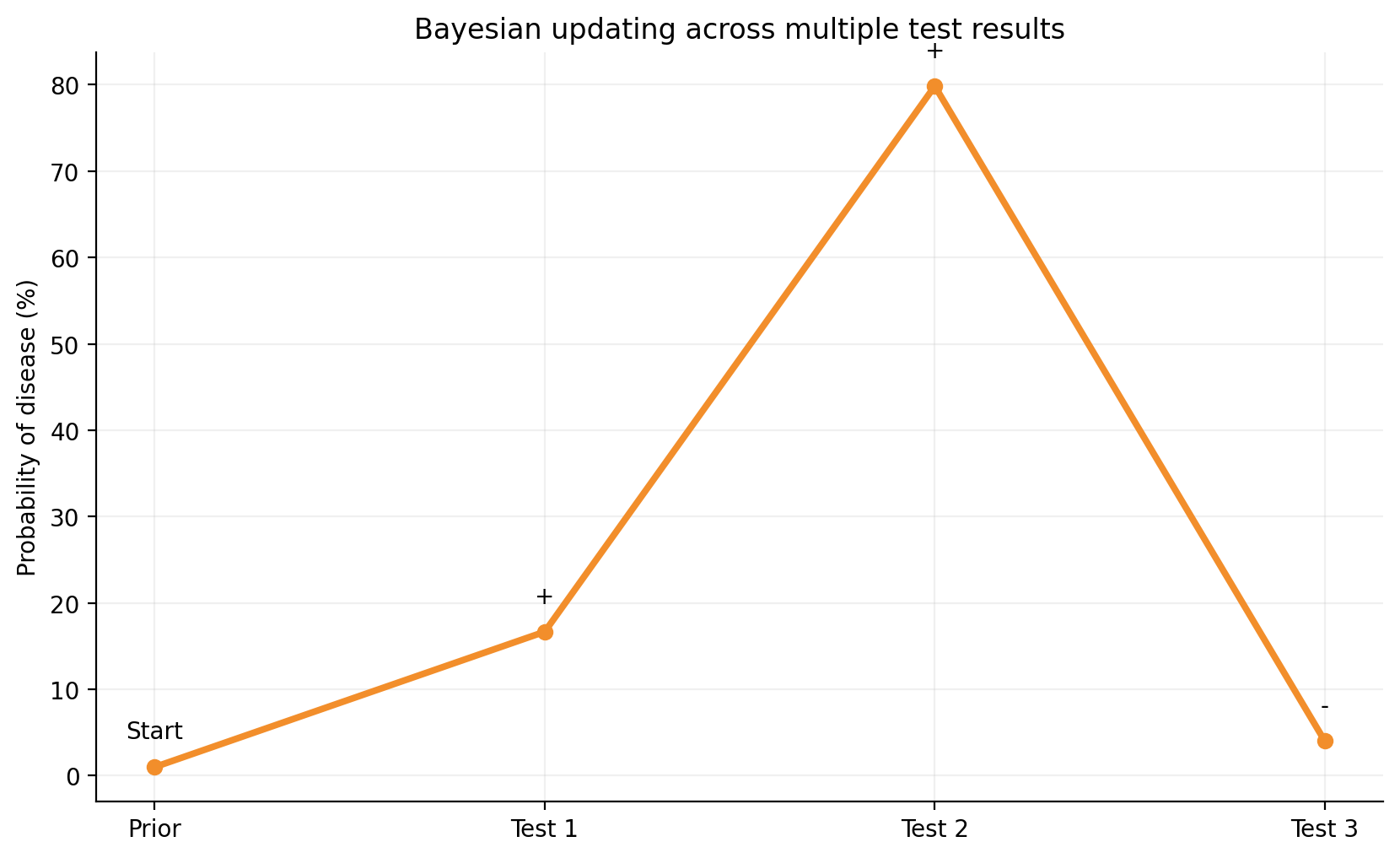
Answer: The medical-testing example becomes much more realistic when you update repeatedly.
Suppose:
disease prevalence starts at 1%
you observe three test outcomes in sequence
the outcomes are positive, positive, negative
After each observation, you use the previous posterior as the new prior.
Interview Check: Why is sequential Bayes especially natural for repeated measurements or tests?
Because each new result can be incorporated by treating the current posterior as the next prior, so evidence accumulates step by step.
Q17. Why do machine-learning implementations often use log probabilities instead of multiplying many tiny numbers directly?
Answer: Because direct multiplication of many small probabilities can underflow numerically.
In theory, multiplying likelihoods is fine. In practice, if you multiply hundreds of tiny numbers, a computer may store the result as 0.0.
Direct product: 0.0
Log score: -1842.068
Stable posterior from log scores: [9.817e-01 1.800e-02 3.000e-04]
This is the same reason the Naive Bayes example later uses log probabilities before converting back to normalized scores.
For students, this is a nice bridge from probability to real software engineering:
the math says multiply probabilities
the implementation says sum log-probabilities
both represent the same ranking logic
Interview Check: Why are log probabilities useful in Bayes-based machine-learning code?
They avoid numerical underflow and turn large products of tiny probabilities into manageable sums.
Part 5: Bayes in Machine Learning
Q18. Why does Bayes’ theorem matter in machine learning?
Answer: Bayes matters because many ML tasks are really about comparing competing explanations for observed data.
Unnormalized scores: [0.02  0.027 0.012]
Posterior: [0.339  0.4576 0.2034]
Best by unnormalized scores: Model B
Best by posterior: Model B
This is a very useful developer-level insight:
if you need the exact probabilities, normalize
if you only need the winning class, comparing unnormalized scores is often enough
Interview Check: Why can P(data) be ignored in MAP class comparison?
Because it is the same constant for every candidate class on that specific input, so it does not affect which posterior is largest.
Q20. What common mistakes should students avoid when using Bayes’ theorem?
Answer: Most Bayes mistakes are conceptual, not algebraic.
Here is a strong checklist:
Do not confuse P(H | E) with P(E | H).
Do not ignore the prior or base rate.
Do not forget the evidence term that normalizes the result.
Do not assume conditional independence blindly just because Naive Bayes does.
Do not treat a high-accuracy test as equivalent to a high posterior.
If you remember only one practical sentence, let it be this:
Evidence changes belief relative to where you started.
That sentence is the spirit of Bayes’ theorem.
Interview Check: What is the single most common conceptual mistake in Bayes problems?
The most common mistake is confusing the probability of the hypothesis given the evidence with the probability of the evidence given the hypothesis.
Q21. What practical recipe should I use in exams, interviews, or coding tasks?
Answer: A repeatable solving recipe is often more valuable than memorizing isolated examples.
Use this five-step workflow:
Name the hypothesis clearly.
Name the evidence clearly.
Write down the prior, the relevant likelihood(s), and any complement rates.
Compute the evidence by summing all ways that evidence can happen.
Form the posterior and check whether the result makes intuitive sense.
In practice, your notes often look like this:
Step
Question to ask
1
What exactly am I trying to estimate?
2
What evidence was observed?
3
What is the starting probability before the clue?
4
How likely is the clue under each competing case?
5
What is the total probability of the clue overall?
6
Does the final answer pass a sanity check?
Strong sanity checks include:
if the evidence strongly favors the hypothesis, posterior should rise
if the evidence is common under every explanation, posterior should not change much
if the prior is tiny, even strong evidence may still leave the posterior far from certainty
For coding tasks, the same workflow becomes:
store priors in scalars or arrays
compute likelihood-weighted scores
normalize with a sum
verify the posterior sums to 1
if values get tiny, use log probabilities
That is the practical Bayes mindset students and developers both need.
Interview Check: What is the best first step before plugging numbers into Bayes’ theorem?
Clearly define the hypothesis and the evidence so you do not confuse which conditional probability you are computing.
Quick Interview Round
1. Why is Bayes’ theorem often described as a belief-updating rule rather than only a formula?
Because its real purpose is to revise uncertainty after new evidence arrives.
2. In one line, what is the difference between prior and likelihood?
The prior is what you believed before the clue; the likelihood is how compatible the clue is with a given hypothesis.
3. Why is the evidence term sometimes called a normalizer?
Because it rescales the numerator so the posterior becomes a valid probability.
4. Why can a rare event still dominate a posterior if the evidence strongly favors it?
Because a strong likelihood can overcome a weak prior when the observed evidence is far more compatible with that hypothesis.
5. What is the intuitive meaning of a posterior probability of 0.8?
It means that after updating with the evidence, the hypothesis has an 80% probability under the model being used.
6. In one sentence, what is conditional probability?
It is the probability of an event after restricting attention to a smaller world where another event is already known to be true.
7. Why is the evidence term often the hardest part for beginners?
Because it usually has to be built by adding together all the different ways the observed evidence could occur.
8. What does the law of total probability do in Bayes problems?
It computes the overall probability of the evidence by summing over the mutually exclusive routes that can produce it.
9. If the likelihood is the same under both the hypothesis and its alternative, what should happen to the posterior?
It should stay close to the prior because the evidence is not informative.
10. Why is base rate essential in medical testing?
Because the rarity or commonness of the condition strongly affects how a test result should be interpreted.
11. What is the difference between sensitivity and specificity?
Sensitivity measures how often true cases test positive, while specificity measures how often healthy cases test negative.
12. What does a large false-positive count teach in a rare-disease problem?
It shows that even a good test can produce many misleading positives when most people are healthy.
13. Why is a posterior not the same thing as test accuracy?
Because the posterior depends on the prior and the overall evidence rate, not just the test’s sensitivity or specificity.
14. What does it mean to normalize Bayes scores?
It means dividing raw likelihood-times-prior scores by their total so the final probabilities sum to 1.
15. Why is sequential Bayes natural for streaming evidence?
Because each posterior can be reused as the next prior, letting belief evolve as new evidence arrives.
16. Why are log probabilities especially common in text classification?
Because text models often multiply many tiny feature probabilities, which is numerically unstable without logs.
17. What is the practical meaning of MAP prediction?
It means choosing the hypothesis or class with the largest posterior probability.
18. Why does Naive Bayes sometimes work well despite its unrealistic assumption?
Because the simplified model can still rank classes effectively even when feature independence is only approximately true.
19. When should you switch from scalar Bayes to vectorized NumPy Bayes?
When you need to compare many hypotheses or process repeated updates efficiently and clearly.
20. What is the best sanity check after computing a Bayesian posterior over multiple hypotheses?
Check that all posterior probabilities are non-negative and sum to 1.
Summary
Bayes’ theorem becomes much easier when you stop seeing it as a scary fraction and start seeing it as a structured answer to one question:
how should evidence change belief?
This post moved through that question in stages:
from plain-language intuition
to conditional probability and the formula’s denominator
to counts, areas, and base-rate intuition
to positive and negative medical-test updates
to NumPy computations, multiple hypotheses, and sequential evidence
to machine-learning ideas like Naive Bayes, log probabilities, and MAP
If that structure feels clear, then Bayes has already started working for you. The theorem is no longer just a formula you remember. It becomes a way you think.